The world of search engine optimization (SEO) is never dull. Just when you think you’ve got it all mastered, Google will usually come up with something new to keep you on your toes. Google’s goal is to provide the absolute best user experience (UX), and since user expectations are continually changing so is the search engine’s approach to keeping them happy.
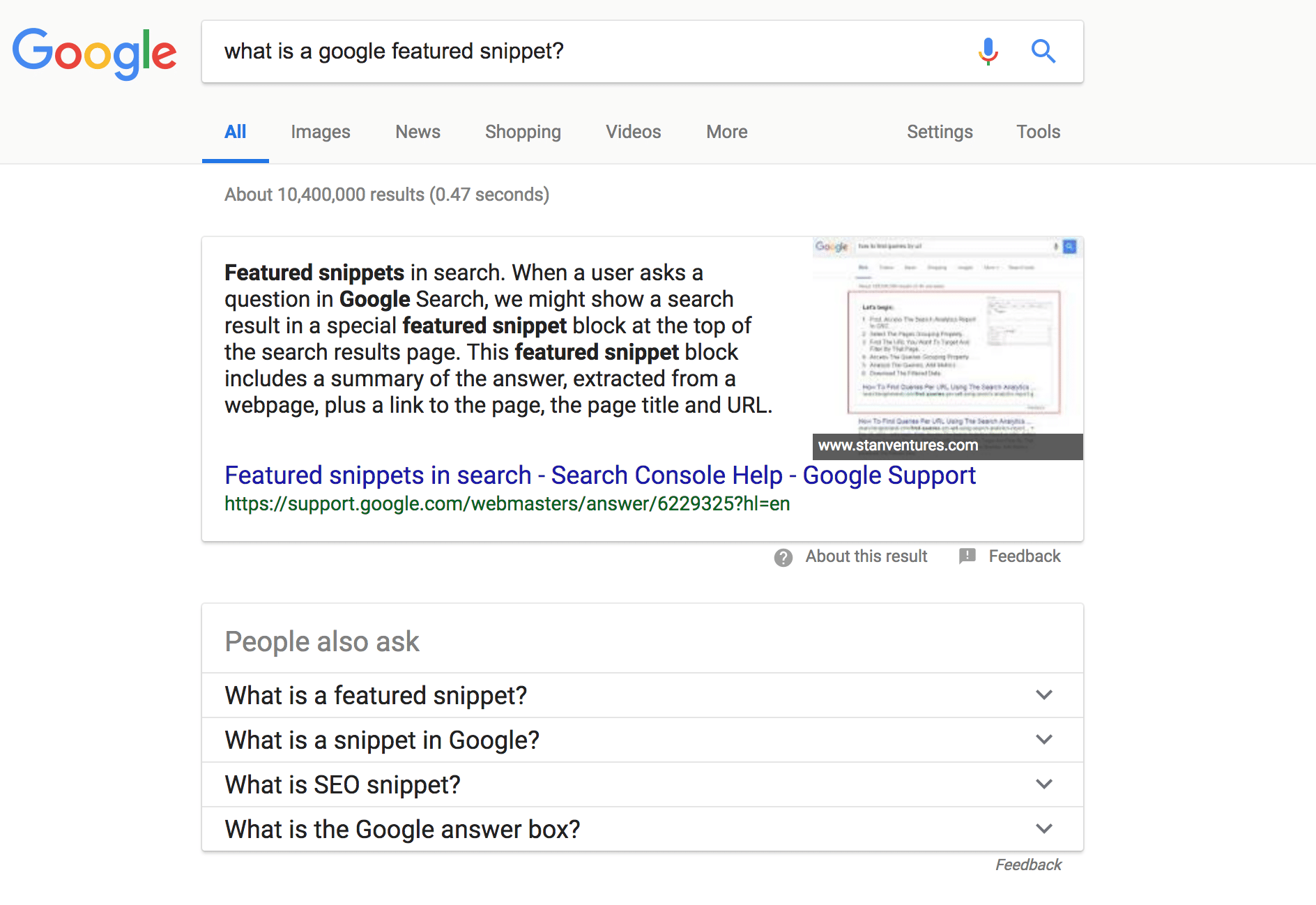
One example of this is the introduction of featured snippets. It’s been a few years since Google introduced featured snippets, also known as position zero. However, as with all things SEO, it took some time for it to catch on and for businesses to learn how to optimize their chances of appearing there. Today, position zero provides massive visibility for companies and is the new goal for SEO.
Understanding What Position Zero Means in SEO
You’re likely familiar with the concept that you want to rank as high as possible on page one Google’s search engine results. The higher, the better, but can you actually do better than the number one position? Yes, let us introduce you to position zero.
The goal of position zero is to answer a search engine user’s query right there on the first page. From Google’s perspective, this provides a high level of UX that makes users happy. From a business standpoint, position zero is the ultimate way of gaining visibility and traction.
Featured snippets are displayed right above the number one ranked spot, which is why it’s called position zero. Keep in mind that the webpage that wins this coveted spot might not be the highest ranked for the query, it’s just the one that Google decided did the best job of providing an immediate answer to a user’s question.
For example, if a user enters the query “What are the best colleges in the United States?” a position zero listing might be a paragraph that describes a college that recently earned the distinction of being number one, or the featured snippet could be a bullet list of the top 10 colleges.
Getting to Zero
There’s an energized focus in search engine marketing to get to position zero, but achieving it requires a different set of strategies than merely ranking high in search results and they all revolve around content.
The first step is to realize that position zero features an answer to a question. This means that when you’re creating content, you want to focus on providing answers in a way that they can easily be pulled out and displayed. For example, short paragraph answers, lists and bullet points dominate position zero.
Secondly, we know this doesn’t come as a surprise, but keyword research is a must. The way users are asking questions to search engines is different than it has been in the past. Local SEO and the rise of the use of voice devices means that keywords need to reflect a more natural language pattern rather than a short, choppy string of words.
Consult SEO Experts
Finally, the key to ranking in position zero is to connect with a professional that can help you navigate the intricacies of achieving this coveted spot. We provide the expert SEM and SEO services you need to optimize your digital presence. Contact us today to learn how our experts can improve your digital business.
With the increase of voice searches, one question repeatedly comes up – is voice search the death of SEO? While voice is definitely changing the way we go about search engine optimization, SEO principles certainly aren’t going anywhere.
Now isn’t the time to push search engine marketing aside figuring it’s futile with voice users. Instead, it’s time to embrace the changes and move forward into the future. For those of you wondering what this means, here’s how voice search is changing the future of SEO.
How Natural Speech Patterns Will Affect SEO
One of the most notable ways that voice search is changing SEO is in the natural speech patterns of voice users. For example, it used to be that a local restaurant wanting to optimize their SEO would focus on keywords like “Best Mexican restaurant near me”. Today, voice searchers are more specific and using natural language in their queries. That same search query would probably look something like “Where is the best Mexican restaurant that serves empanadas in Smithville”. This is a very basic example, but it serves to illustrate that stark contrast between text and voice-based SEO.
Local SEO Growth
This can provide a huge boost to local businesses looking to get maximum impact from their SEO. Consumers are more likely to use voice search on mobile devices when they are out and about, looking for a local business. They’re also more likely to search out something very specific – be it a menu item, specific service or location. By optimizing content to meet their local customer’s needs, voice search actually gives an advantage to small businesses who often see unimpressive results from the high ranking keywords used by the “big guys”.
Optimizing Content to Answer Key Questions
We can look back at the above example to see that not only do voice searches resemble natural speech patterns and contain more words, they’re also often formatted in the style of a question. Think back to the last time you typed a search into Google. It was probably a flat, somewhat incoherent statement that contained only a few words. Voice search is completely different.
From a SEM perspective, it becomes important to optimize content so that it’s easy for search engines to identify common search queries in question form. For anyone who has ever created content and tried to figure out how to seamlessly integrate choppy keyword phrases, this comes as a nice relief.
Moving forward, SEO content should be built around answering the questions your customers have, including the natural language patterns they use when seeking out answers through voice-activated devices. Look for content to become even more meaningful and relevant for voice searches – something that will be great for your overall SEO.
Partnering with an Experienced Voice Search Team
Voice isn’t the death of SEO, but it is changing it. Our digital marketing team offers a complete range of SEO services that will help you reach a growing number of voice search users. Contact us today to learn more about the future of voice for your business.
Are you looking for an SEO company for your law firm or trying to figure out if your SEO company is focusing on the right things? It’s unfortunate that there are a lot of SEO companies that make big promises yet can’t deliver – and we are tired of it. We get a lot of clients who’ve had bad experience with their SEO agency and it takes a lot of work to rectify their wrong-doings.
So, with that being said, we’d like to provide you some information on what has been successful for our attorney clients running an SEO campaign with us.
These 6 elements are not the only aspects to consider in your attorney SEO campaigns, but absolutely should be top priorities. Take a look:
Proper Site Architecture
Your site architecture consists of the pages on your website, their hierarchy and overall navigability. You should have a page for each type of service you offer – not a single page with all of your services listed on it.
Why? You’ll have a much better chance of ranking if you provide high-quality content and only optimizing for 4-5 tightly themed keywords on a single page. Google is more likely to serve a page that is had good value and explicitly about the query the user was searching rather than serving a page where the content is only a small piece of the overall content.
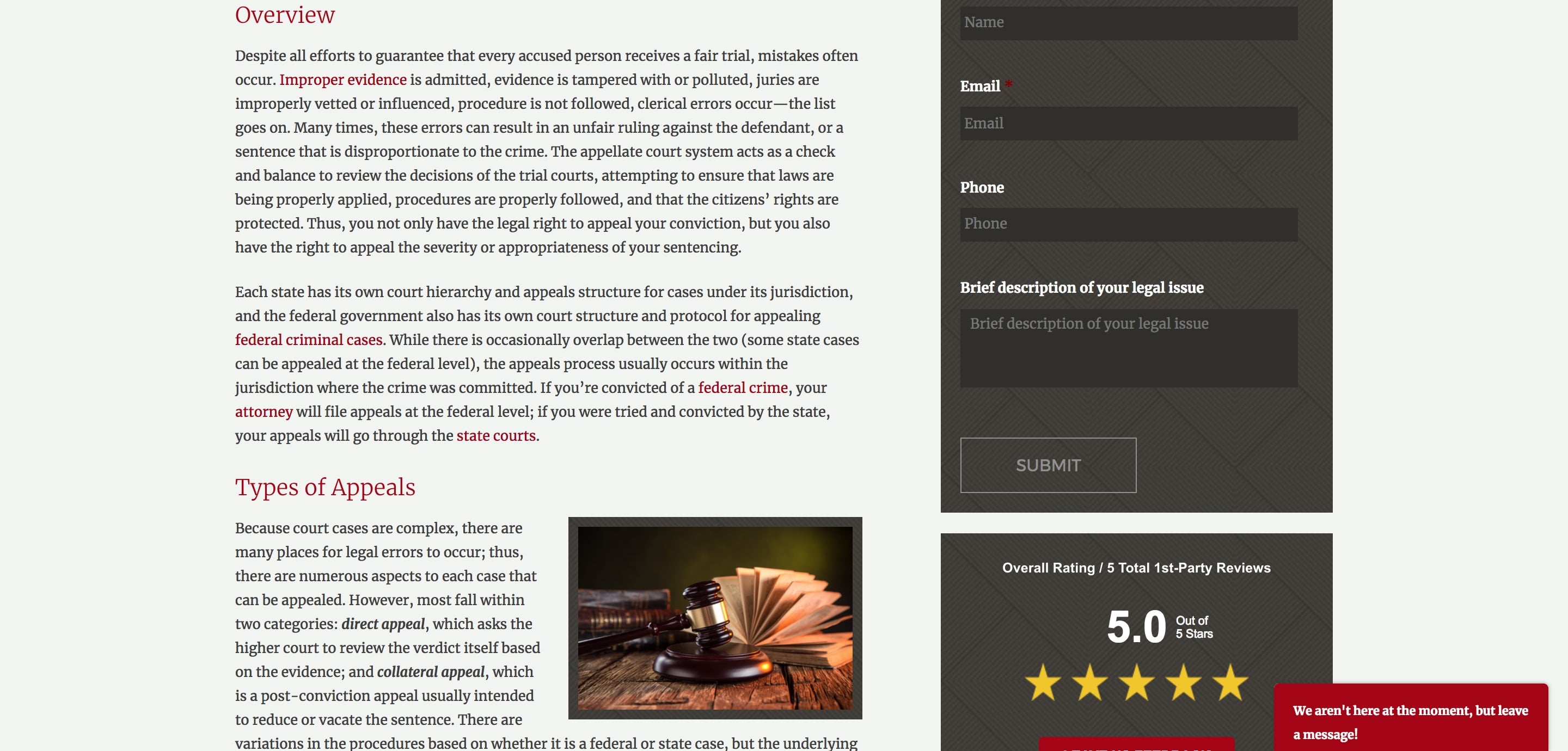
If you are a criminal defense attorney, you should a page for each type of crime you represent (i.e. drug crimes, white collar crimes, etc.). These pages should provide value to users by explaining an overview of the crime, common questions or scenarios, what to do in certain situations and so on. If someone was charged with a crime, the respective crime page should answer any and all questions the user might have about the process and how you can help.
Here is a sample site architecture that heads in the right direction:
Homepage
About Us
Services
Appeals
Federal Appeals
State Appeals
Direct Appeals
Collateral Appeals
Indictments
Federal Indictments
State Indictments
Trials
Federal Trials
State Trials
Crimes
Drug Crimes
White Collar Crimes
Juvenile Crimes
Tax Fraud
Blog
Contact Us
Notice how each services is broken out into subservices as well. This allows us to target each page for certain keywords and provide valuable content around it.
What to avoid:
Home
About Us
Services
Blog
Contact
There is no way you can go into detail about each specific service on one Services page. Your site architecture should mimic your businesses services offerings at the most detailed level.
Title Tags & On-Page Optimization
Now that we have a solid site architecture in place, we need to optimize each page title, meta description and on-page copy for best performance.
Following the site architecture above, it’s time to perform keyword research for each page to determine our page title. The page title is what shows up as the clickable link in the search results. So, for the Appeals section of services, we may optimize the title tags similar to this:
Appeals – “Appeals Attorney | Firm Name”
Federal Appeals – “Federal Appeals Attorney | Firm Name”
State Appeals – “Appellate Attorney for State Appeals | Firm Name”
Direct Appeals – “Direct Appeals Attorneys | Firm Name”
Once you’ve optimized title tags, you’ll need to focus on meta descriptions and the on-page copy. Use proper HTML to organize your content, implement headers for sections using the proper hierarchy and ensure your targeted keywords appear naturally.
Pillar Content
These top-level services pages are what we call “pillar content.” This is the content that we want to rank in the search engines for our high-value, competitive terms, like “federal appeals attorney.” These pages need to have long-form content and should cover all major aspects of the service, common questions and what your process of providing a solution looks like.
Provide as many different types of media that makes sense. Some people like to read, some like to watch videos and others might want to look at pictures. Providing various forms of content tells Google that you are optimizing your page for all types of users and will help to rank even better.
You’ll want to do some in-depth keyword research to make sure different variations of your keywords are being used. But most importantly, focus on making sure you are providing valuable content – not just pushing how great your firm is.
Supplemental Long-Tail Articles
Now that we have our pillar content in place, it’s time to start generating supplemental blog articles to support it. These blog articles should be focused on long-tail versions of your main keywords and should link back to your pillar content. You do not want to repeat what’s already been said in the pillar content – again, this is supplemental content that should go further into a specific matter.
If we have our Federal Appeals page (pillar content), a good example for a supplemental blog article would be “What Jurisdiction Does The Federal Court Of Appeals Have?”
We like to focus our supplemental content on answering common questions – these articles will then link back to the pillar content for supporting documentation. Typically, if we can get a user to click into the pillar content, we have a good chance of getting a conversion.
Link Building
Links pointing to your website from other relevant, high-quality websites are one of the most important factors in ranking in the search engines. Link building is a tedious process and takes a solid strategy to see good results.
Starting off, you’ll want to make sure you are listed in all relevant local business directories – websites like Yelp, Merchant Circle, Google My Business, etc. These links are fairly easy to obtain and are free. It just takes times to build out an optimized profile for each.
Guest posting is a great way to build links as well. Guest posting is the process of reaching out to 3rd-party websites, offering free, value-adding content that their user base would enjoy and include a link pointing back to our website within the content.
DO NOT – I repeat – DO NOT build links from websites that have nothing to do with your industry. Google’s algorithm does a great job in sniffing out spammy links that were created solely for trying to manipulate search engines. Link building is probably something you should let an expert handle.
List Placements
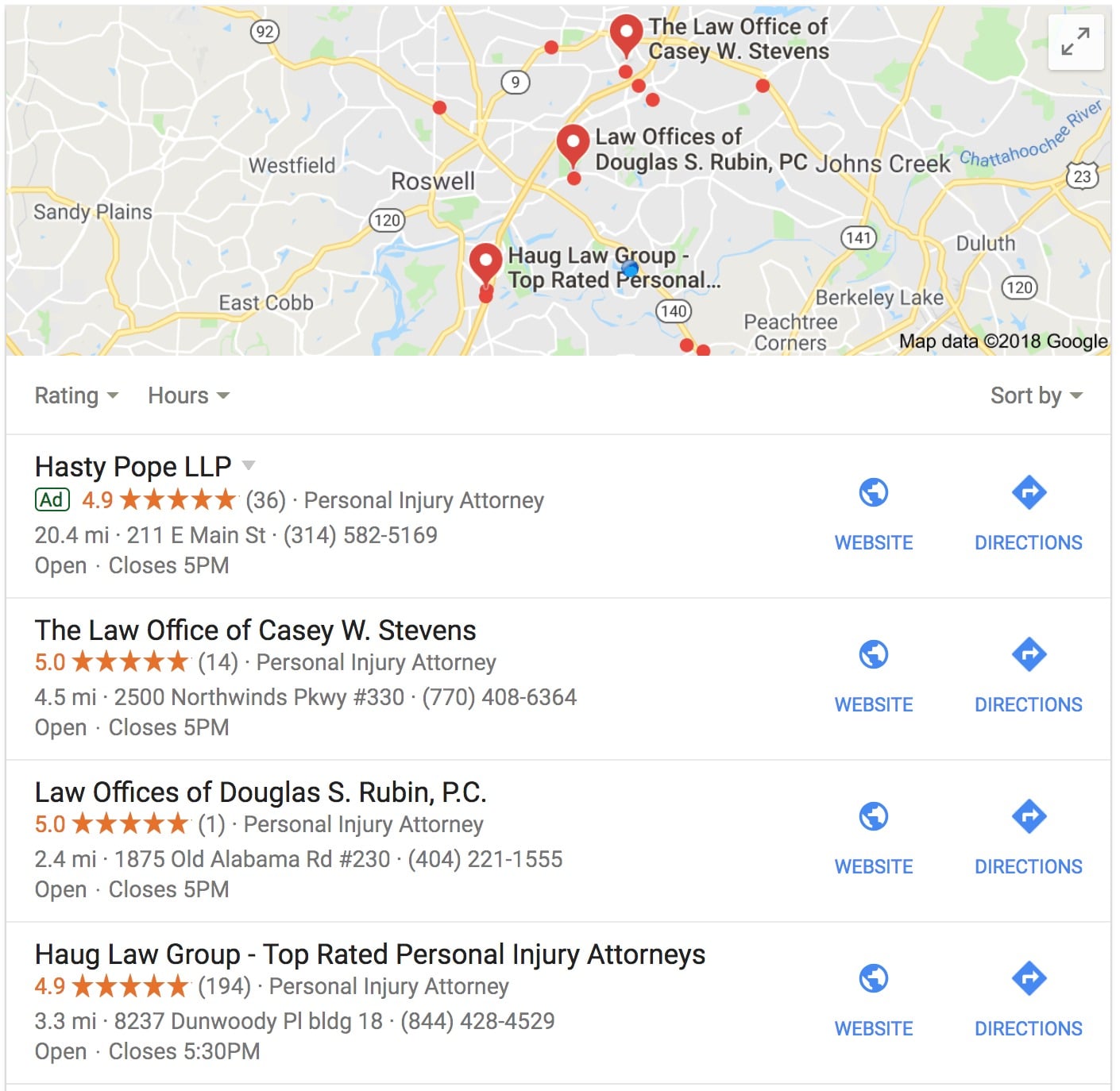
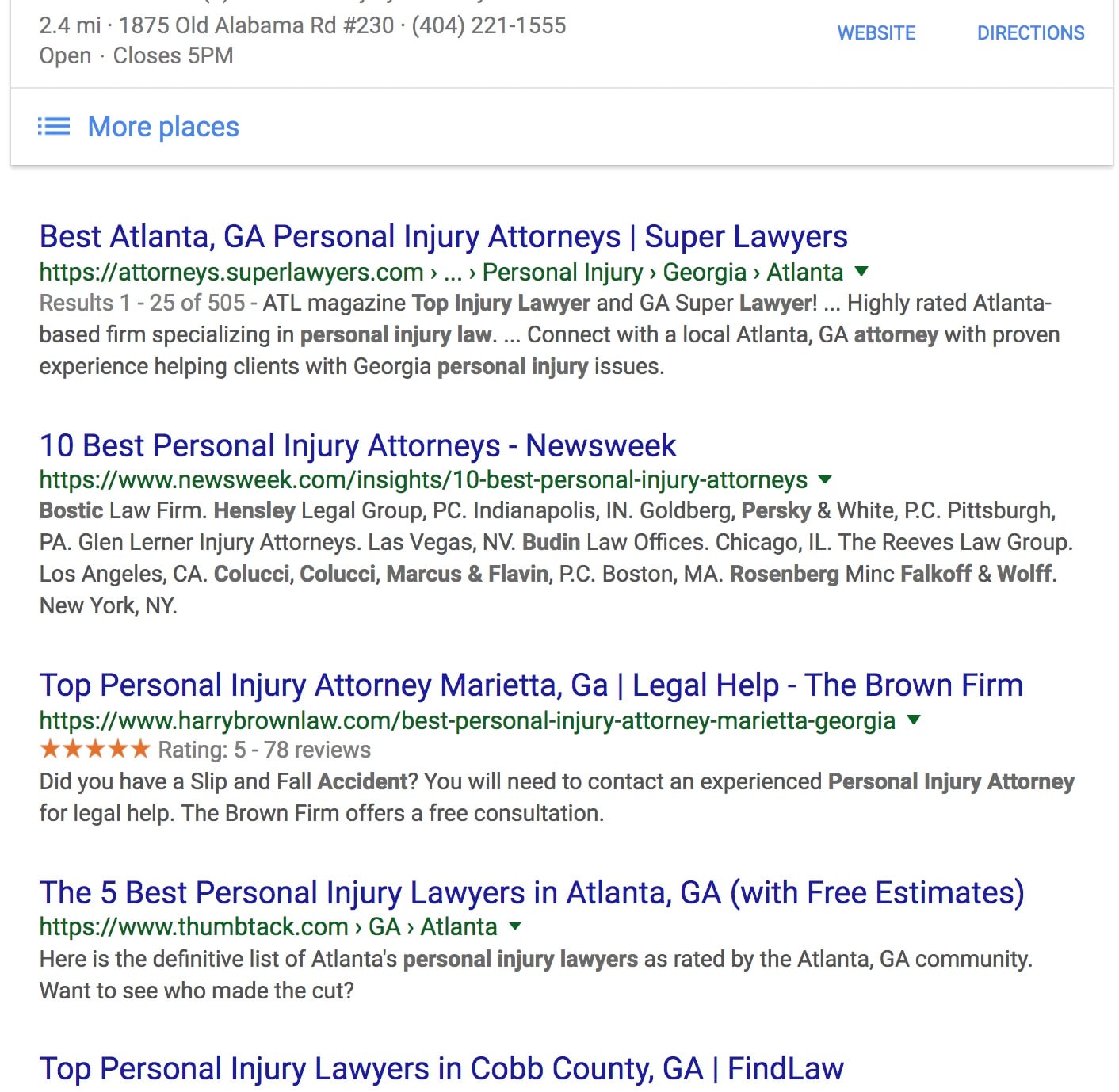
List placements for attorneys consists of paying for a premium spot on a list provided by known lawyer-related website directories like FindLaw, SuperLawyers, Avvo and Justia. For example, if you search in Google for “top personal injury attorney” you’ll likely get a result from SuperLawyers in the first organic position titled “Best Personal Injury Attorneys in [city_name].
Some might disagree, but we believe that paid listings are apart of search engine optimization. While these lists cost money to be included on, you still get SEO value from the link pointing to your website on your profile page. The main reason we consider list placements as part of SEO is because we formulate our decisions on which lists to pursue based on search volume of a certain keyword and how high that list ranks.
For instance, following the “top personal injury attorney” example mentioned above, we can see that query is searched approximately 390 times per month across the United States. That doesn’t seem like much, but I see a related query for “personal injury attorney” gets 33,000 searches per month in the US. When searching that query in Google, I get the same list.
Knowing what we know about click through rates at different ranking positions, we can assume that list, if ranking #1, will receive about 52% of the clicks. So, if we know we are paying for a top spot on that list and it receives about ~17,000 visits per month, this might be a good list to be on.
Need help?
We know attorney SEO campaigns like the back of our hand and would love to have a conversation on how we can help your law firm. Take a look at our SEO process, our attorney SEO case study and give us a call when you’re ready to talk.